Flora MacDonald (1725-1790)
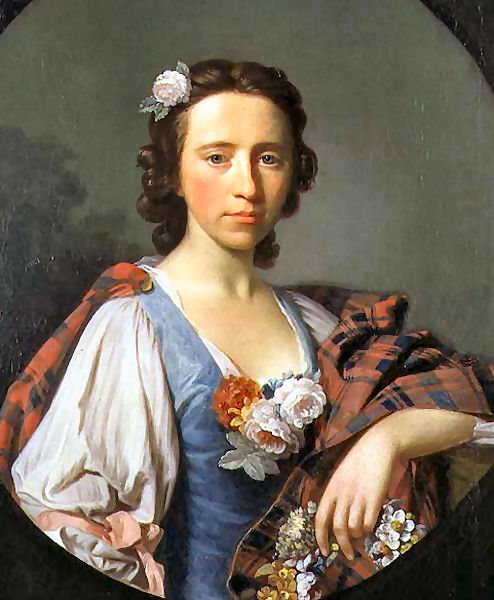
Fionnghal NicDhòmhnaill
by Allan Ramsay (1713 - 1784)
In this portrait, painted in 1749 after
she had been released from the Tower of London and before her
marriage to Allan Macdonald of Kingsburgh in 1750, she wears in her hair the
white rose, a Jacobite
emblem; the flowers in her hand no doubt allude to her Christian name.
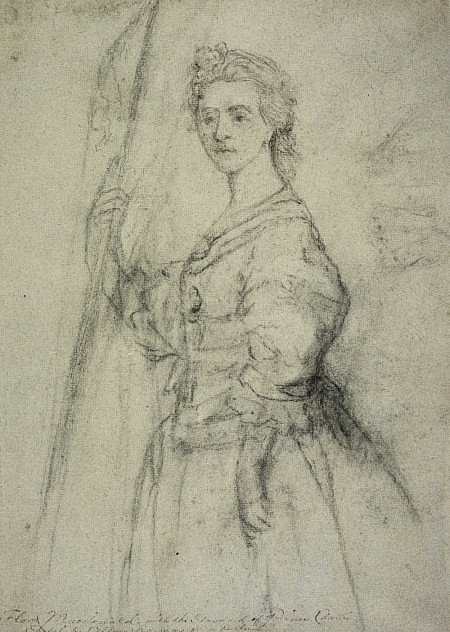
Ramsay's Flora takes on a
classical pose and the rural costume and flowers in her hair, and the
royal standard she proudly
holds, are reminiscent of the portrayal of mythological shepherdesses.
This chalk on paper drawing of Flora Macdonald was made by the famous
eighteenth-century portrait painter Allan Ramsay.
According to the inscription at the bottom, it was ‘for a picture’, but the only
painting of Macdonald by Ramsay (above) bears little resemblance to this sketch.
Flora MacDonald was born to Ranald and Marion MacDonald at
Milton on South Uist in the Outer Hebrides, Scotland, in 1722. When Flora
was about a year old, her father, a tenent farmer, died. After her mother
remarried (to another MacDonald), it is believed that she lived with relatives,
such as her father’s people Clanranald, who oversaw her education.
Unfortunately, much information about Flora MacDonald’s early life is lacking
substance and has taken on the characteristics of a folktale. John J. Toffey in
A Woman Nobly Planned examines the historiography of Flora MacDonald, dispels
many of the myths, and helps sort out the particulars of her adventures. The
following comments draw heavily upon Toffey’s research as it is more grounded in
historical method than many of the earlier tales of Flora MacDonald’s life. Any
inconsistencies with local lore will be better explained in Toffey’s text. See
references.
She was visiting
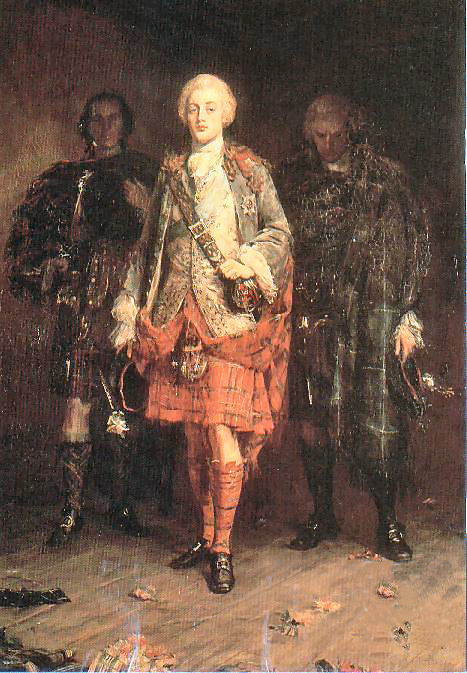
her brother in South Uist during the summer of 1746 when asked to assist Charles
Edward Stuart, known as "Bonnie Prince Charles"
On April 16, 1746 Culloden Moor (about 6 miles East of
Inverness) was the scene of an
historic battle in the Scottish Jacobite
rebellion led by the pretender to the British throne,
Prince Charles Edward
Stuart, who was attempting to depose George II, King of Great Britain.
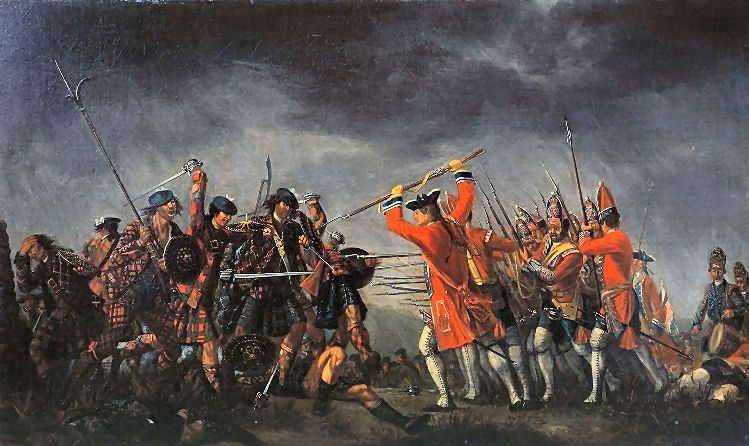
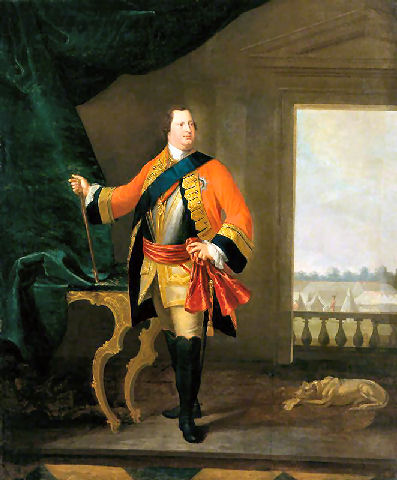
The
battle resulted in a total rout of Charles Edward's army, consisting of about
7,000 Highlanders, by a force of
9,000 British regulars led by the British
military leader and son of George II, William Augustus, Duke of Cumberland
(1721-1765)

It has been said that there was a brief romance between Bonnie
Prince Charles and Flora MacDonald of Benbecula during that summer of 76.
For two months Charles, being on the run after defeat at Culloden, had been
jumping from hiding place to hiding place in the Outer Isles before he and Flora
met. Now had it not been for a kinswoman of Flora's the two may never have
met at all.
There are three ways of regarding the Prince of Scotland;
there were the heart-loyal people who believed implicitly in his Divine Right
to be King and were prepared to spill their last drop of blood for him; there
were those who found the whole escapade frightening and unsettling after 30
years of Hanovers and either fought firmly against the Jacobites or subscribed
to letters of gratitude and hero-worship sent in their name to the man others
called 'Butcher Cumberland'; the third group were honest people, content
enough with the stodgy Georges who had given them a kind of peace, people
who had kin serving in their armies or in the King's Government, but who would
not have sent to death a bonnie Stuart beauty like the Pretender Prince, not for
all the ransom money offered by their government.
Now Flora was
not pinning away for the Bonnie Prince but was deeply in love with her husband
to be Allen MacDonald who was a redcoat officer throughout the campaign.
Both her fiance' and her foster-father, Captain Hugh MacDonald of Sleat,
were members of King George's army. But Flora would have never seen the
Prince betrayed even though she had no sympathy for the Jacobites. It came
about one day that Flora was asked to do more than "not betray".
It seemed to those on the inside that she would be the most likely young woman
on the island to guide Charles on the next stage of his journey to find refuge
on the mainland.
When a Captain of the Troop first approached her she prudently
refused.
"I wish the Prince no ill, and would like to see him safe. But I
cannot join a plot like that for there are those of the King's men that are my
kin."
The Captain replied, "But it is your very own
Foster-Father who has thought of this plan to have the Prince taken safely to
Skye."
Knowing how kindly a man was her Foster-Father, Flora believed
that indeed he would be behind such a plan as this. Not only that but she
could see the disquiet that the Prince's presence had brought to Benbecula and
knowing surely if he were gone away things would once again return to normal.
"What will be thought of me if I spend
so much time alone with the Prince?" asked Flora, not really bothered
by it but knowing people would talk.
"I will have Neil MacDonald attend you, but if you fear
of your reputation Ma'am, I will wed you before the escape. I would do
this for my Prince; though it would be no hardship or so great a punishment
Ma'am." the Captain said gallantly.
Laughing, Flora said, "That sacrifice will not be
necessary Sir but... " thinking of Allan, she hesitated and said no
more on the matter.
"Your kinswoman Miss Allie MacDonald was also asked but
she dare not serve the Prince, I thought you had more spirit than that
Ma'am." said the Captain. And that was all that Flora needed to
hear!
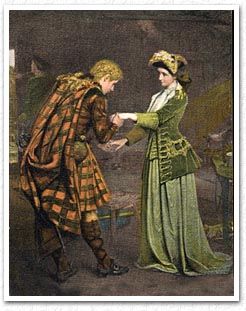
Also disputed is the reason for and the means by which Flora
MacDonald became involved in a plot to help usher Prince Charles Edward Stuart
to safety. Current scholarship indicates that it was likely through her
stepfather Captain Hugh MacDonald, despite his loyalty to the Crown. Regardless
of the circumstances, however, Flora obtained passports for herself and an Irish
servant named Betty Burke, who was the “Young Pretender” (the Prince) in
disguise. The Prince was to be disguised in a frock as "Betty
Burke" an Irish maidservant. Flora thought the scheme
"fantastical" but was persuaded to go ahead. June 20th 1746 was
the day that the young Prince and Flora finally met and after a week of hiding, Miss Flora MacDonald, Neil MacDonald and the strange looking
"Betty Burke" made the famous journey.
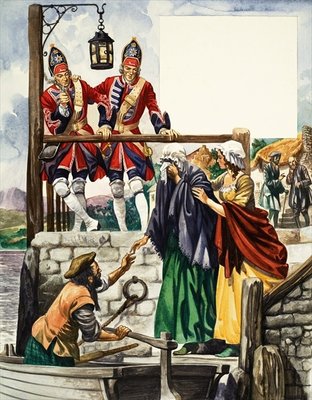
The unlikely pair set off from Uist on June 28, 1746 by boat
with a small crew of Highland sympathizers, rowing the boat to Skye evading
capture on the way and eventually landing between Uig and Mogstad in Kilmuir, at
what is now called Rudha Phrionnsa (Prince's Point). 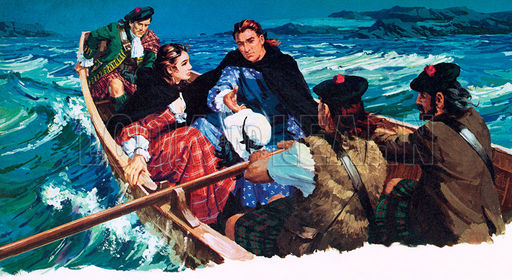 They hid overnight in
a cottage and then traveled, over the next few days, overland to Portree, at one
point avoiding some redcoat troops. The two conspirators parted ways at the inn
in Portree on June 30, 1746. Before he left for the island of Raasay and a ship to France,
the Prince gave Flora a locket with his portrait, saying "I hope, madam,
that we may meet in St James's yet". He sailed on the French
privateer L'Heureux on September 20, 1746. She never saw him again. After
arriving at Skye, Flora sent the boat crew back to Uist. It was those men who,
when confronted there by the King’s forces, betrayed the plan and the
whereabouts of the Prince and his guide. They hid overnight in
a cottage and then traveled, over the next few days, overland to Portree, at one
point avoiding some redcoat troops. The two conspirators parted ways at the inn
in Portree on June 30, 1746. Before he left for the island of Raasay and a ship to France,
the Prince gave Flora a locket with his portrait, saying "I hope, madam,
that we may meet in St James's yet". He sailed on the French
privateer L'Heureux on September 20, 1746. She never saw him again. After
arriving at Skye, Flora sent the boat crew back to Uist. It was those men who,
when confronted there by the King’s forces, betrayed the plan and the
whereabouts of the Prince and his guide.
About ten days later, Flora was captured. She was imprisoned on
various ships and in Dunstaffnage Castle, Oban
and briefly in the Tower of London. She was released in 1747 under a
general amnesty. By the time of her release she had become a celebrity at
home and abroad. Flora maintained throughout her life that she helped the
fugitive as she would help any person in need. Although she became a Jacobite
heroine, the cause was never one to which she claimed loyalty.
She met Samuel Johnson, the English essayist during his tour of
Scotland. Johnson described her as "a woman of middle stature,
soft features, elegant manners and gentle presence."
On the 6th of November, 1750 occurred the wedding of Flora and
Allan Macdonald, son of the Macdonald of Kinsgburgh, who befriended the Prince.
He is described as being one of the most handsome and powerful Highlanders in
his clan and possessed of all the qualities which constitute the true gentleman. 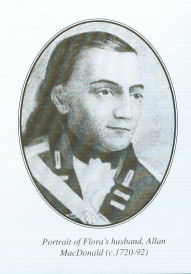 They made their home in Flodigarry. Later, after the death of her
husbands father, they moved to Kingsburgh.
They made their home in Flodigarry. Later, after the death of her
husbands father, they moved to Kingsburgh.
In 1774, following difficult financial times, the couple emigrated to
North Carolina with five of their seven children.
They landed at Wilmington and traveled up the Cape
Fear River to its furthermost navigable point: the Highland Scots community of
Cross Creek (now Fayetteville) in Cumberland County.
Their eldest
daughter Anne and her husband Alexander MacLeod arrived at about the same time.
Her stepfather Hugh MacDonald and her half-sister Annabella were already in the
colony. Annabella and her husband, Alexander MacDonald, lived at Mount Pleasant,
Cameron Hill, now Cameron
in modern Harnett County, North Carolina where Flora and her family spent the winter of
1774-1775.
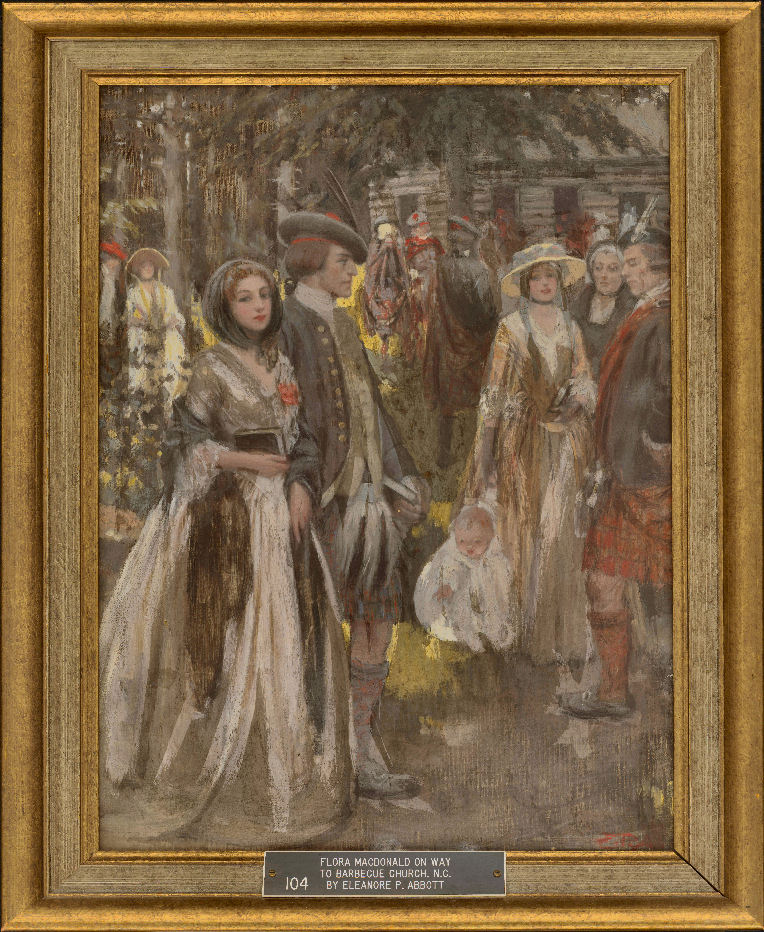
Presbyterian Historical Society, Presbyterian Church
(U.S.A.)
Courtesy of Leah Gass
Allan and Flora were members of Barbeque Church. A
description of Flora is
here.
History of Barbeque Church, document page 22 of 58
(14)
Later,
the family settled on a 500 acre estate named "Killegrey" along
Cheeks Creek, near Pekin, in present day Montgomery
County where they raised cattle and engaged in the profitable colonial trade of
producing pine products called "naval stores."
But before being allowed
to settle, Flora and her family had to sign an oath (promise) never to oppose
the British government.
 Hundreds of Highlanders who settled in North Carolina after Culloden were still
haunted by the oath which they had been obliged to sign. This fearsome document
which was not revoked until 1782 was calculated to keep back any Highlander who
signed it from even the appearance of disloyalty. The oath reads:
Hundreds of Highlanders who settled in North Carolina after Culloden were still
haunted by the oath which they had been obliged to sign. This fearsome document
which was not revoked until 1782 was calculated to keep back any Highlander who
signed it from even the appearance of disloyalty. The oath reads:
I, . . . . . .do swear and as I shall answer to God at the
great day of judgment, I have not, nor shall have
in my possession any gun, pistol or arm whatsoever, and never use tartan, plaid
or any part of the
Highland garb; and if I do so may I be cursed in my undertakings, family and
property; may I
never see my wife and children, father, mother or relation; may I be killed in
battle as a coward,
and lie without burial, in a strange land, far from the graves of my forefathers
and kindred -
may all this come across me, if I break my oath.
The family’s new
life was soon interrupted by the outbreak of the American Revolution. True to
the sworn oath, the MacDonald family joined the Tory cause at the outbreak of
the fighting. Flora’s husband, Allan became a major in the service of the
British Army and recruited soldiers for the loyalists in North Carolina. Her son
Alexander and son-in-law, Alexander McLeod were also Tory officers. In February
1776 Royal Governor Martin called for the Highlanders to march from Cross Creek
to join forces with the British at Wilmington. Departing
from Cross Creek on February 18, 1776, the "Highland Marchout" the MacDonalds took up arms with other Highlanders bound for the
Battle of Moore’s Creek Bridge.
A legend survives that Flora
MacDonald cheered the departing men in her native Gaelic language while seated
upon a white horse.
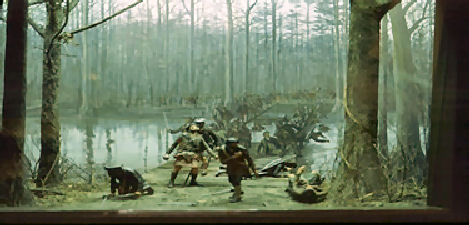
But disaster came a few days later when orders were to rush a bridge at Widow
Moore's Creek. "Some seven hundred or more Loyalists, including all their
chief officers were defeated by the Patriots and taken prisoners.
The private soldiers were released under bonds not again to take up arms.
Allan Mcdonald and his son remained prisoners until eighteen months later, when
they were released on parole and exchanged in New York in November, 1778 for
American officers of equal rank in the hands of the British. Allan
rejoined his regiment in Nova Scotia."
"Thoughout those terrible months of distress and fear Flora suffered all
the anguish which war brings, but made no complaint. Owning to the part
she had taken in the early months of the Revolution, she was made to endure the
consequences, and the family of Kenneth Black, with whom lived after she left
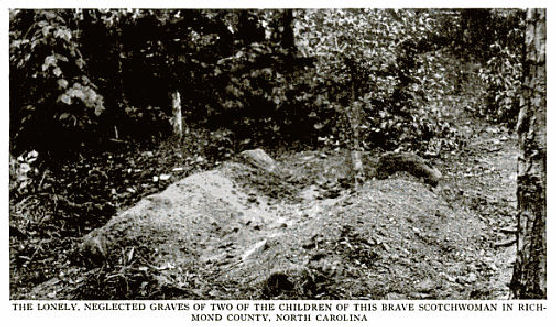
Killiegray, had to suffer also. Meanwhile, two of her children had died,
and were buried at Killiegray. She could seldom hear from her husband, but
at length a letter came, advising her to return to Scotland. She was loath
to leave her dear ones in America, her heart was sad as she thought of those
lonely graves of her children at Killiegray.
 However, in 1779, she
had the opportunity to secure passports for herself and her youngest daughter,
Fanny, as far as Wilmington, and decided to venture upon the long journey home.
At Wilmington, in order to meet her expenses Flora sold her precious silver,
prized because of its beauty of old English craftmanship, more prized because it
was the gift of admiring friends in London, when as "the Prince's Preserver" she
was the center of popular interest. They succeeded in getting to
Charleston and there took passage on a British vessel to Scotland. However, in 1779, she
had the opportunity to secure passports for herself and her youngest daughter,
Fanny, as far as Wilmington, and decided to venture upon the long journey home.
At Wilmington, in order to meet her expenses Flora sold her precious silver,
prized because of its beauty of old English craftmanship, more prized because it
was the gift of admiring friends in London, when as "the Prince's Preserver" she
was the center of popular interest. They succeeded in getting to
Charleston and there took passage on a British vessel to Scotland.
The voyage from America to Scotland was marked by an engagement
between the British vessel and a French warship. In the thick of the
fight the British seamen appeared to waiver. At this point, Flora sprang
forward and incited the men to new courage and victorious effort. She
suffered a broken arm for her daring part in the conflict.
Upon arrival Flora MacDonald lived with her brother in
Scotland until her husband was discharged.
In Nova Scotia, in 1783, Allan Mcdonald of the 84thRegiment was
given his discharge as an officer on half-pay. He rejoined his wife in
Skye and they lived a few quiet years together on the Kingsburgh estate.
On the 4th of March, 1790 she died in the same bed in which
Bonnie Prince Charles had slept. Her death was deeply mourned by the
people of Skye and following a large funeral she was buried at Kilmuir in a
sheet in which the Prince had slept as her shroud.
She was laid to rest while the pipers played the "Coronach", the lament for
departed greatness.
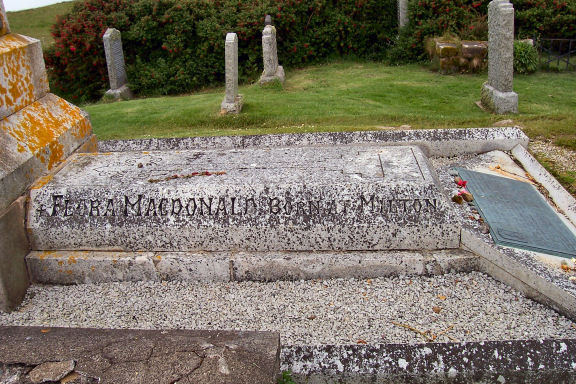
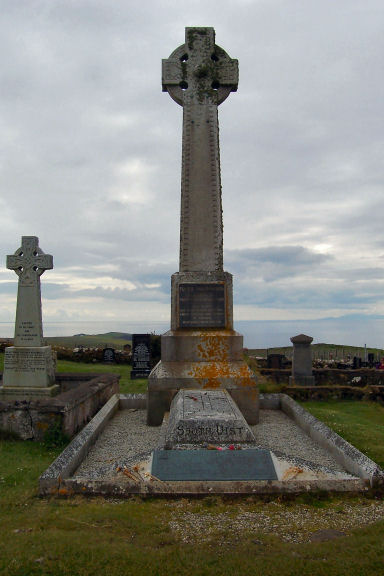
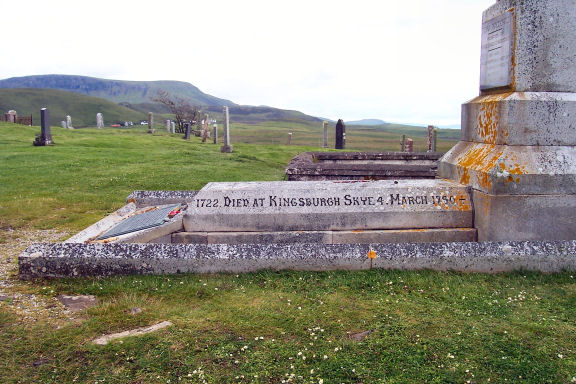
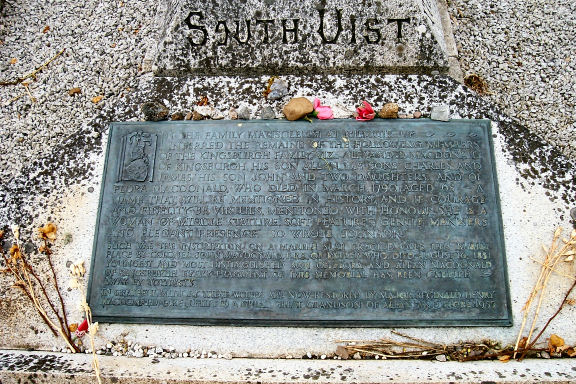
To this day her
grave is one of the most visited sites in Scotland.
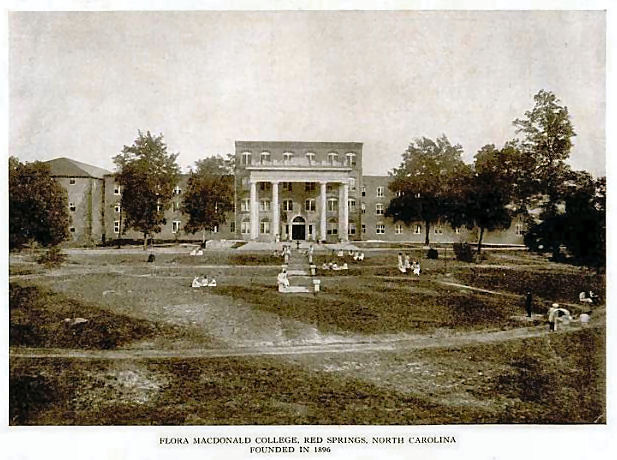
Her legacy remains
in the Cape Fear region as well with a school in Red Springs that bears her
name
and serves as the location of the Flora MacDonald Highland Games where each
fall hundreds of people
gather for competitions, musical performances and socialization to promote
Scottish culture and heritage.
The spirit of
Flora MacDonald serves as an example of courage and honor to all who admire
her.

This area is incomplete and is in the process of additional
photos and information
Interesting Links
References:
"Flora Mcdonald"
A History and a Message from James Alexander Mcdonald, DD, LLD"
Flora Mcdonald College
Copyright 1916 Scottish Society of America
John J. Toffey, A Woman Nobly Planned: Fact and Myth in the Legacy of Flora
MacDonald (1997) William S. Powell, Dictionary of North Carolina Biography IV,
138-139—sketch by Maud Thomas Smith Samuel A. Ashe, Biographical History of
North Carolina (1907), Rosalind Mitchison, A History of Scotland (1970)
SKETCHES OF DISTINGUISHED FEMALES
By Jo. Seawell Jones, of North Carolina
Miss Flora MacDonald
Carolina Observer, (Fayetteville, NC) September 02, 1834
Acknowledgement:
The text in quotations on this web page was derived from "contained in this web page has been compiled from many sources,
including other web sites. Credit is therefore given to others who have
spent their time and effort. |