SUPPORT OUR TROOPS
Operation Iraqi Freedom
Timeline and Photo stories

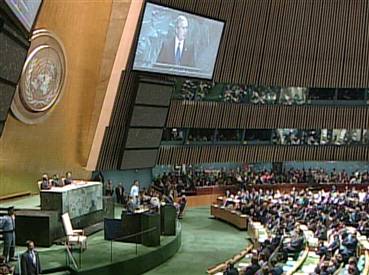
September 2002 - US President George W Bush
tells skeptical world leaders at a UN General Assembly session to confront the
"grave and gathering danger" of Iraq - or stand aside as the US acts. In the
same month British Prime Minister Tony Blair publishes a dossier on Iraq's
military capability.
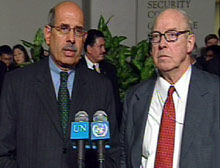
Chief U.N. weapons
inspector Hans Blix and IAEA head Mohamed ElBaradei say weapon inspections could
take "in the vicinity of a year and frankly we think it is worth to wait to get
a sustainable and long term peaceful solution."
March 17, 2003 - UK's ambassador to the
UN says the diplomatic process on Iraq has ended; arms inspectors evacuate; US
President George W Bush to give Saddam Hussein and his sons 48 hours to leave Iraq
or face war.
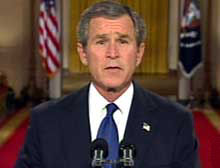
Tuesday, March 18, 2003. The ultimatum came in a
13-minute, televised speech from the White House.
Saying the "danger was clear" that
the Iraqi regime would provide terrorists with biological, chemical or nuclear
weapons, President Bush gave Iraqi President Saddam Hussein 48 hours for him and
his sons to leave Iraq before military action begins "at a time of our
choosing."
The 48 hour deadline would arrive at 4 am Thursday in Baghdad, 8 pm
Wednesday EST
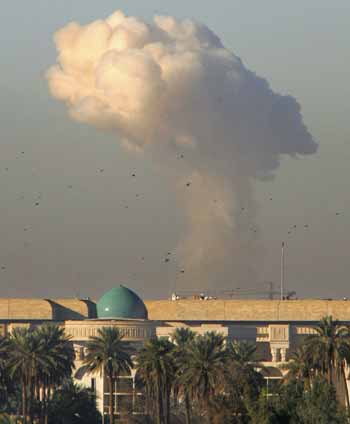
March 20, 2003 - American missiles hit targets
in Baghdad, marking the start of a US-led campaign to topple Saddam Hussein.
In the following days US and British ground troops enter Iraq from the
south.
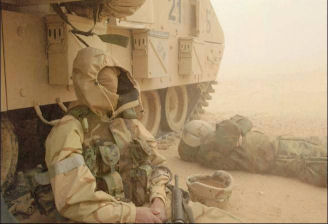
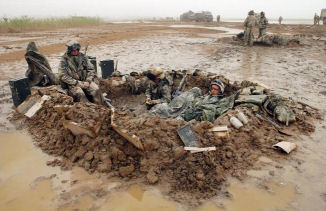
Beginning with sandstorms and rains after crossing from
Kuwait into Iraq.
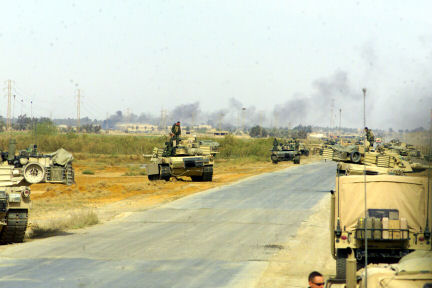
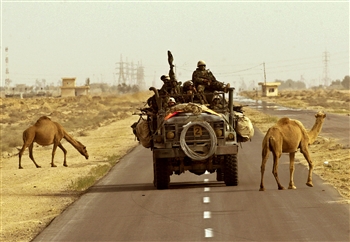
Charlie Co. 1st Tank Bat. moves east along Highway 27 Camel crossing
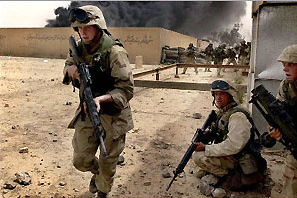
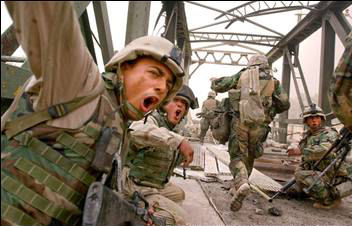
Advance on Fedayeen Taking bridge
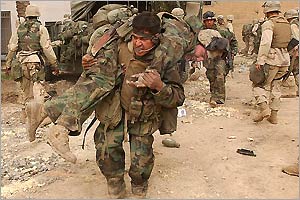 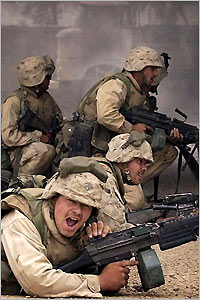 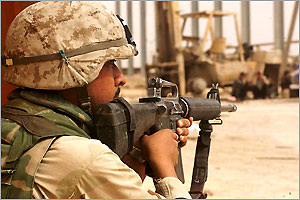
Injured
Marine Cover fire Watch over
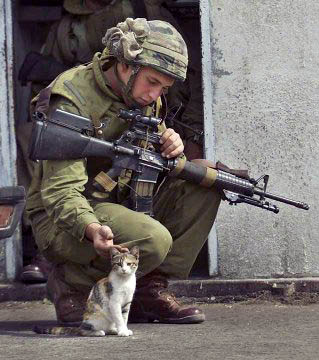
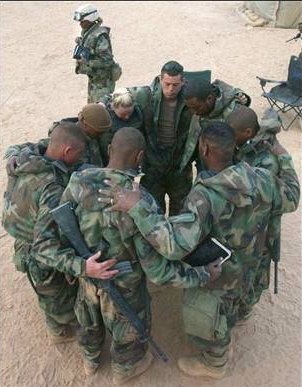
Caring moment Prayer before battle
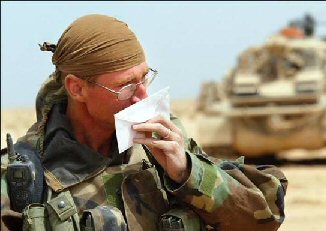
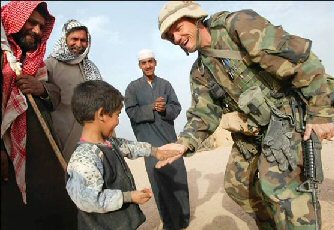
Sweet letter from home Gim'me five
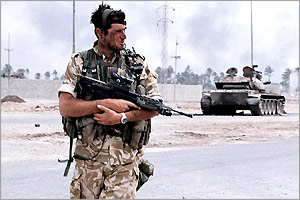
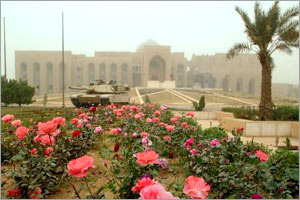
Day 19 - British Royal Marine on patrol in Basra Day 19 - U.S. Tank at Palace
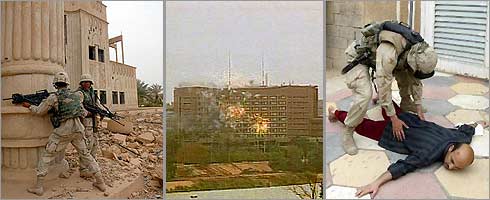
Day 20
Left to right: U.S. troops storm a presidential palace in
Baghdad; blasts rock a government building in Baghdad; U.S. Marine searches an Iraqi civilian while securing a main
road into Baghdad
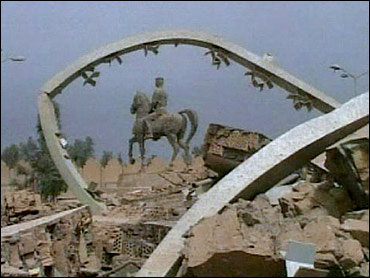
Day 20 - A statue of Saddam Hussein is seen through the
rubble of Special Republican Guard headquarters, after U.S. troops stormed
the complex.
April 9, 2003 - US forces advance into central
Baghdad. Saddam Hussein's grip on the city is broken. In the following days
Kurdish fighters and US forces take control of the northern cities of Kirkuk and
Mosul. There is widespread looting in the capital and other cities.
BAGHDAD, Iraq — In a scene of triumph and jubilation
televised live throughout the world, Iraqi citizens in the heart of Baghdad --
with help from a large U.S. military vehicle -- toppled a huge statue of Saddam
Hussein Wednesday and began dancing on it when it fell to the ground.
April 9, 2003 - Day 21 of the war.
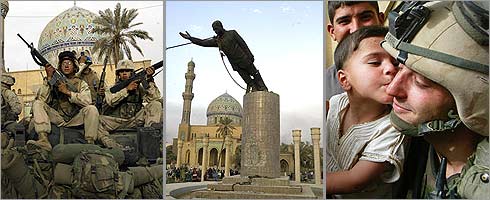
Day 21
Left to right: U.S. soldiers arrive in the center of
Baghdad; a statue of Saddam Hussein is pulled down in Baghdad; an Iraqi child kisses a U.S. soldier
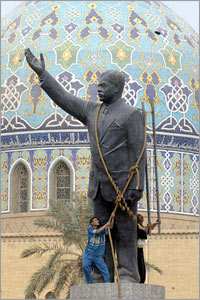
Iraqi citizens try to topple statue of Saddam in Firdos
Square in the heart of Baghdad.
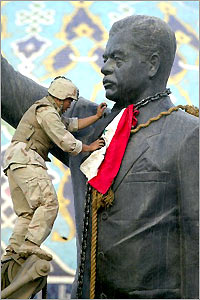
A U.S. soldier hangs an Iraqi flag around the chain that will
pull down the statue.
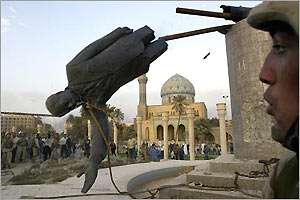
Day 21
The statue is brought down by an American M-88 Tank Recovery
vehicle
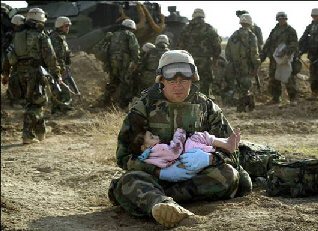
Innocent victims of battle
Brig. Gen. Vincent Brooks shows a cards featuring Iraqi regime members.
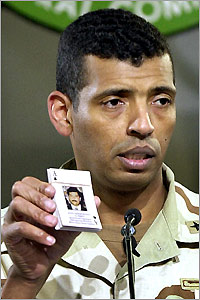
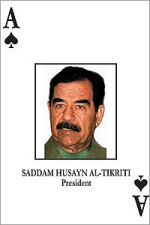
April 2003 - US lists 55 most-wanted members of former
regime in the form of a deck of cards. Former deputy prime minister Tariq Aziz
taken into custody.
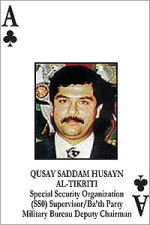
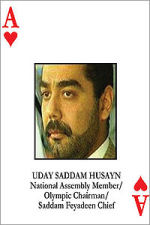
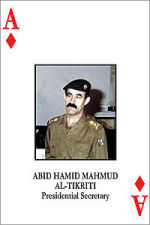
May 2003 - UN Security Council approves resolution backing US-led
administration in Iraq and lifting of economic sanctions. US administrator
abolishes Baath Party and institutions of former regime.
July 2003 - US-appointed Governing Council meets for first time.
Saddam's sons Uday and Qusay killed in gun battle in Mosul.
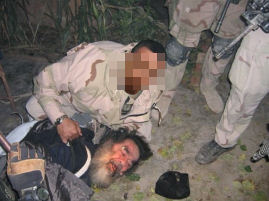 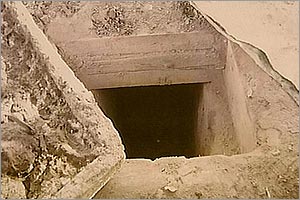 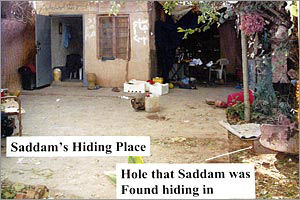
December 14, 2003 - Saddam Hussein captured in Tikrit
hiding in a hole in the ground.
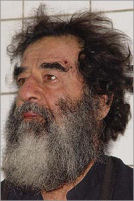
Saddam in custody
The Beginnings of Democracy in Iraq
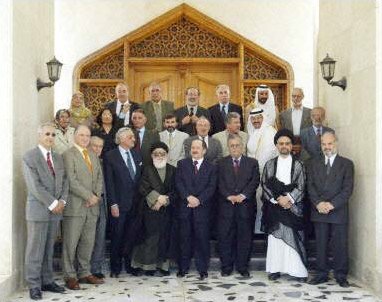
Iraqi Interim Governing Council
On 13 July 2003, the Iraqi Governing Council was formed with
25 members and was the provisional government
of Iraq established by the US led multinational coalition.
The Council consisted of various Iraqi political, religious, and tribal
leaders who were appointed by the Coalition Provisional
Authority to provide transitional leadership of the country to
an eventual democratic state.
The Council's ethnic and religious breakdown included 13
Shi'ites, 5 Sunni Arabs, 5 Kurds (also Sunnis), one ethnic
Turk and an Assyrian Christian.
In September 2003, the Iraqi Governing Council gained
regional recognition from the Arab League, which agreed to seat
its representative in Iraq's chair at its meetings. On June 1,
2004, the Iraq Interim Governing Council dissolved after
choosing council member Ghazi Mashal Ajil al-Yawer as the new
Iraqi president of the Iraq interim government.
Monday, March 8, 2004
BAGHDAD, Iraq -- Calling it a new beginning for their country, Iraqi Governing
Council
members Monday signed an interim constitution, the
Transitional Administrative Law (TAL), laying the groundwork for future
elections,
a permanent constitution and eventually a return to self-rule.
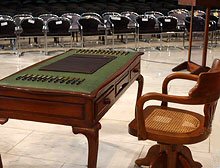
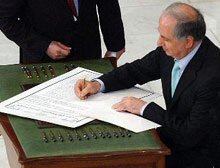
Ahmed Chalabi signs the interim constitution Monday in
Baghdad.
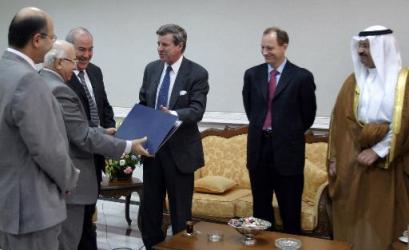
Transfer of Sovereignty from the Coalition Provisional
Authority to the Iraqi leaders.
New Iraqi President of the Iraq Interim Government, Ghazi
Mashal Ajil al-Yawer
New Iraq Prime Minister, Iyad Allawi
Ambassador John Negroponte and Paul Bremer
Early transfer took place 2 days early, June 28th, 2004 .
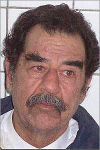
Saddam Hussein transferred to Iraqi legal custody
June 30, 2004 - The former Iraqi leader and 11 top members
of his regime were transferred to the legal custody of Iraq where they will face
charges of genocide, crimes against humanity and war crimes, including those
stemming from the 1980s Iran-Iraq war; the 1988 gassing of Kurds in northern
Iraq and the 1990 invasion of Kuwait.
ELECTION
January 30, 2005 - At approximately 6,000 voting centers
across Iraq, 8.56 million people voted in elections for a Transitional National Assembly. The Shia United Iraqi Alliance wins a majority of assembly seats. Kurdish
parties come second in the poll. Some 58 percent of Iraq's
registered voters turned out for the elections, despite violence that killed
more than 40 people.
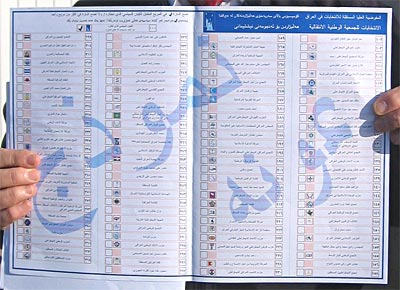
A ballot to be used in the January 30th Iraqi elections is
displayed.
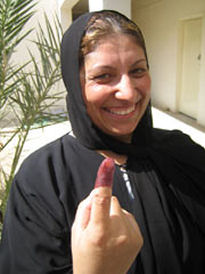
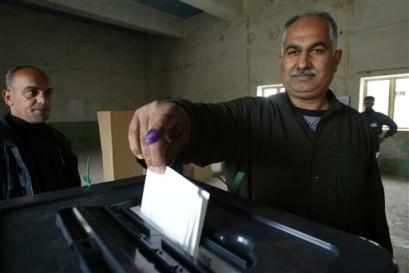
Everywhere in Iraq, citizens proudly displayed their
ink-stained fingers to show that they had voted:
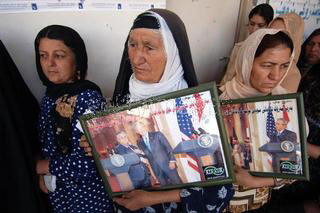
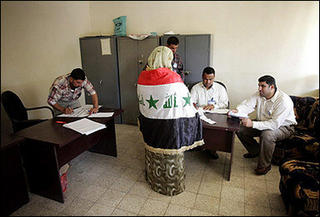
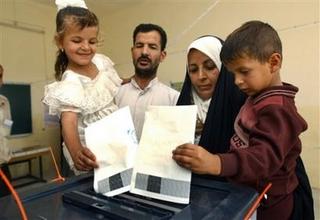
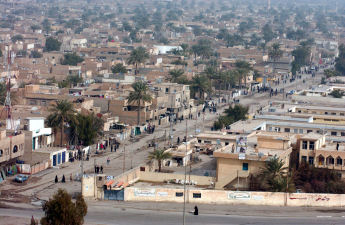
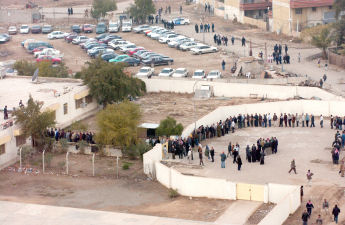
Iraqi citizens stand in long lines outside polling stations
in Baghdad, Iraq, on Jan. 30, 2005. Millions of Iraqis throughout the country
are participating in Iraq's first free election in over 50 years.
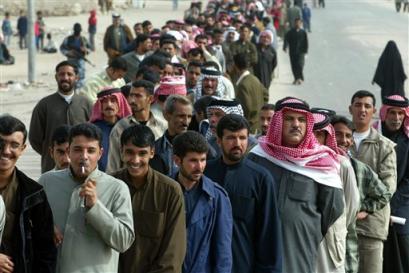
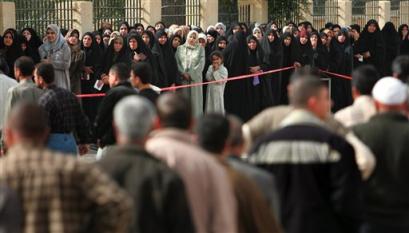
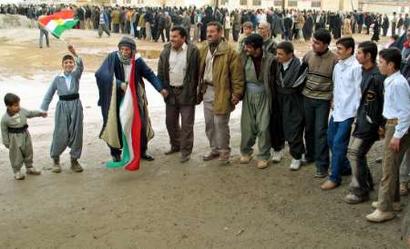
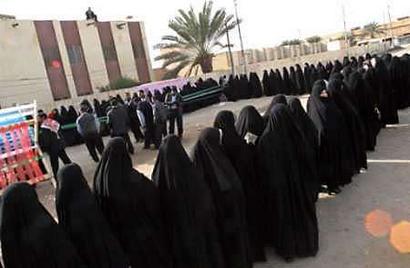
All across Iraq, long lines formed at polling places as a
stunningly high proportion of Iraqis defied the terrorists to exercise their
right to vote.
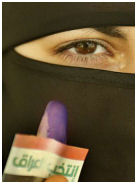
Iraqi women play an important
role in the 2005 election.
The Transitional Administrative Law requires a 25 percent female membership in
the Parliament.
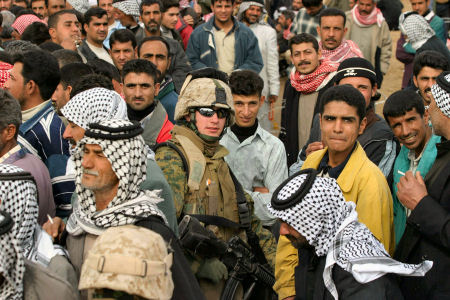
NASSIR WA AL SALAM, Iraq (Jan. 30, 2005) – A Marine with Kilo
Company, 3rd Battalion, 8th Marine Regiment, stands in the middle of the crowd
of voters during the country's first free election in over 50 years.
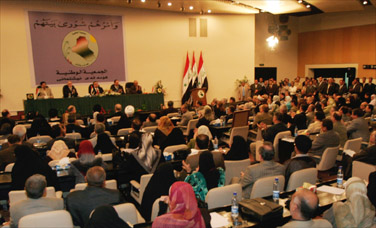
April 2005 - Parliament selects Kurdish leader
Jalal Talabani as President; Ibrahim Jaafari, a Shia, is named as Prime
Minister.
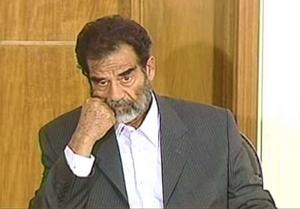 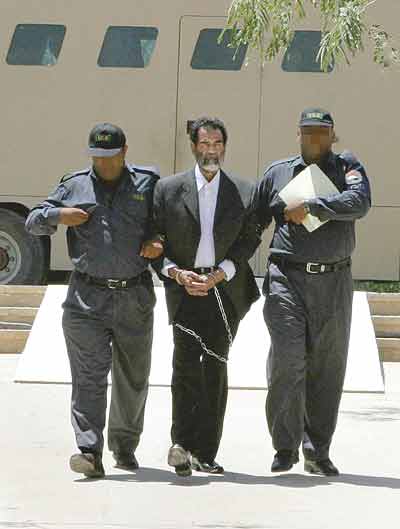 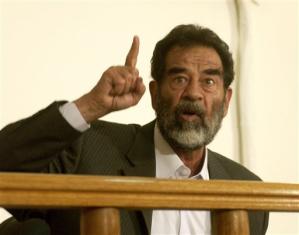
October 2005 - Trial of Saddam Hussein
on charges of crimes against humanity opens in Baghdad.
NEW CONSTITUTION
October 15, 2005 - Iraq votes to approve a new
constitution the purpose of which is to create an Islamic federal democracy.
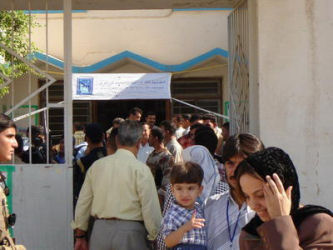
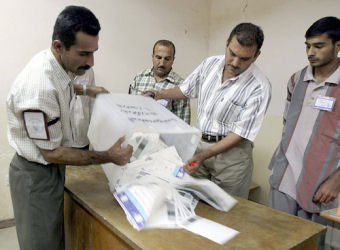
Voting at a Baghdad voting
center
Iraqi referendum workers empty a ballot box
to count the votes.
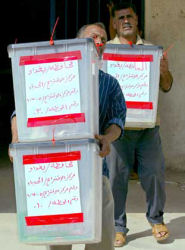
Iraqi election employees collect ballot boxes from a polling
station at Baghdad's poor neighborhood of Sadr city to be transferred to the
headquarters of the Independent Electoral Commission in Iraq.
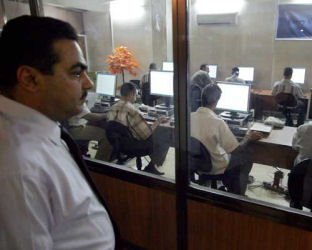
Adel Lami, chief of the Independent Electoral Commission in
Iraq, follows the work of election employees as they enter data from the
referendum at election headquarters in Baghdad.
Saturday, October 15, 2005 from the blog
"Iraq the
Model"
Probably the worst thing today is the intense heat which was
a little over 100f but that didn’t stop the crowds from walking in the sun to
the voting stations, I personally had to walk nearly 4 miles in total but it’s
definitely worth the effort.
The presence of Iraqi army and police units is heavier than it was in January
elections and I also noticed that no multinational forces were on the streets
and the only sign for their presence was the helicopters that patrolled the
skies.
The turnout in our district looks quiet good and actually going to the voting
office was a good opportunity to meet some friends I haven’t seen in months.
I met one friend on the way and when I asked him what would his vote be he said
that he hasn’t decided yet “if I voted yes I would be approving some articles
that I don’t agree with and if I voted no we would go back to where we started
from…” he said and that was really refreshing because this guy who used to
believe in conspiracy theories and stuff like “what America wants is what’s
going to happen” now feels that his vote can make a difference.
posted by Omar
BRAVO to the Iraqi people who just affirmed their own
constitution -- and who are about to go to the polls again December 15th, 2005 to
select the first freely-elected
legislature in the Islamic world --
Saturday May 20, 2006
After five months of often bitter wrangling over Cabinet posts, Iraq's unity
government took office Saturday and vowed to fight the insurgency, restore
stability and set the stage for the eventual withdrawal of U.S. and other
foreign troops.
Iraq's first permanent government since the fall of Saddam
Hussein was approved by parliament and sworn in on Saturday,
despite the failure to fill three ministry posts because of political disputes.
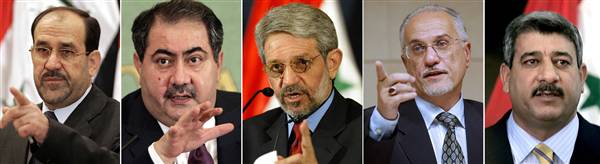
Five key members of Iraq's new government.
From left to right: Prime Minister and acting Interior Minister
Nuri al-Maliki, Foreign Minister Hoshyar Zebari, Finance Minister
Bayan Baqer Solagh, Deputy Prime Minister and acting Defense Minister Salam al-Zoubai
and Oil Minister Hussein Shaheristani.
Iraq's new 39-position National Cabinet, which includes four
women:
Prime Minister: Nouri al-Maliki, Shiite.
Deputy Prime Minister: Barham Saleh, Kurd.
Deputy Prime Minister: Salam Zikam Ali al-Zubaie, Sunni Arab.
Acting Interior Minister: al-Maliki (also prime minister).
Acting Defense Minister: al-Zubaie (also deputy prime minister).
Oil Minister: Hussain al-Shahristani, Shiite.
Finance Minister: Bayan Jabr, Shiite.
Trade Minister: Abed Falah al-Sudani, Shiite.
Foreign Minister: Hoshyar Zebari, Kurd.
Justice Minister: Hashim al-Shebli, Sunni Arab.
Electricity Minister: Karim Waheed, Shiite.
Industry Minister: Fawzi al-Hariri, Kurd.
Water Resources Minister: Latif Rashid, Kurd.
Housing and Construction Minister: Bayan Dazee, Kurdish woman.
Agriculture Minister: Yarrub Nazim, Shiite.
Education Minister: Khudayer Al-Khuzaie, Shiite
Higher Education Minister: Abed Theyab, Sunni Arab.
Health Minister: Ali Al-Shemari, Shiite.
Transport Minister: Karim Mahdi, Shiite.
Migration Minister: Abdul-Samad Rahman, Shiite.
Acting Minister of State for National Security: Saleh (also deputy prime
minister).
Minister of State for Civil Society Affairs: Adel al-Assadi, Shiite.
Minister of State for House of Representatives Affairs: Safa al-Safi, Shiite.
Youth and Sports Minister: Jassim Mohammed Jaafar, Shiite.
Minister of State for Tourism and Archaeology Affairs: Liwa Semeism, Shiite.
Planning and Development Cooperation Minister: Ali Baban, Sunni Arab.
Communications Minister: Mohammed Twafiq, Shiite.
Labor and Social Affairs Minister: Mahmoud Mohammed al-Radhi, Shiite.
Municipalities and Public Works Minister: Riyad Gharib, Shiite.
Environment Minister: Narmin Othman, Kurdish woman.
Culture Minister: Assad Kamal Mohammed, Kurd.
Minister of State for Womens Affairs: Fatin Abdel-Rahman, Sunni Arab woman.
Minister of State for Provincial Affairs: Saad Tahir Abid, Sunni Arab.
Science and Technology Minister: Raed Fahmi, Sunni Arab.
Human Rights Minister: Wijdan Mikaeil, Christian woman.
Minister of State for Foreign Affairs: Rafaa al-Esawi, Sunni Arab.
Minister of national dialogue: Akram al-Hakim, Shiite.
Minister of State: Mohammed Abbas Auraibi, Shiite.
Minister of State: Ali Mohammed Ahmed, Kurd.
Minister of State: Hassan Rhadi Khazim, Shiite.
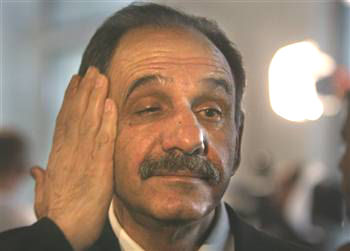
Sunni Arab leader Saleh al-Mutlaq, whose motion to postpone the
inaugural session was turned down by legislators and who walked out of the
inauguration session with about 10 other Sunni deputies, wipes sweat off his
brow after the session inside the heavily fortified Green Zone in Baghdad, Iraq.
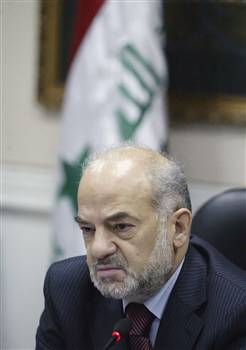
Outgoing Iraqi Prime Minister Ibrahim al-Jaafari
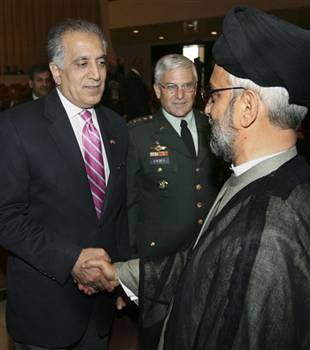
The U.S. ambassador to Iraq Zalmay Khalilzad greets Shi'ite leader Abdul Aziz
al-Hakim
as the U.S. military commander in Iraq General George Casey looks on.
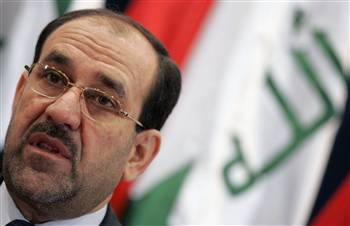
Iraqi Prime Minister Nuri al-Maliki has called on Iraqis to denounce terrorism
and to come together in a spirit of love and tolerance.
GOOD NEWS ANNOUNCED !!!
Abu Musab al-Zarqawi, notorious terrorist and criminal is
dead.
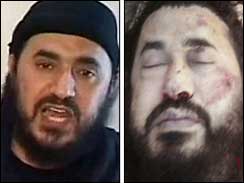
Thursday, June 8, 2006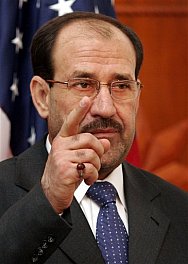
Iraqi Prime Minister Nouri al-Maliki, at a press conference in the heavily
fortified Green Zone in Baghdad, Iraq,
gestures as he announces the news that Abu Musab al-Zarqawi, al-Qaida's leader
in Iraq who led a bloody
campaign of suicide bombings and kidnappings, has been killed in an air raid
north of Baghdad.
Iraqi Prime Minister Nouri Al-Maliki said Zarqawi was killed along with seven
top aides Wednesday evening at
around 6:15 p.m. local time in a bombing raid on a building in a remote area 30
miles northeast of Baghdad in
Diyala province. Zarqawi and his aides were killed in a fortified
safe-house in the little town of Hibhib 8 km
north of Baquba.
Officials said the terror leader's identity was confirmed by fingerprints,
facial recognition and known scars.
DNA was also taken for analysis.
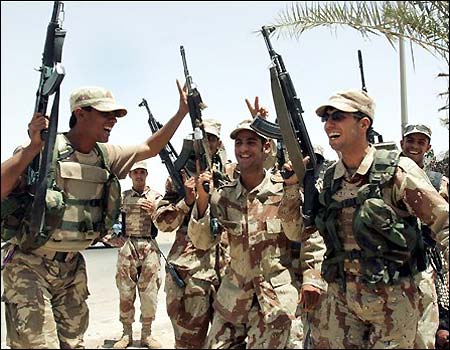
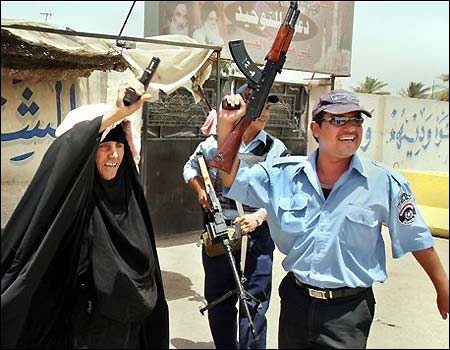
June 8: Iraqi soldiers, elderly woman and police officers celebrate
the news about Abu Musab al-Zarqawi's death.
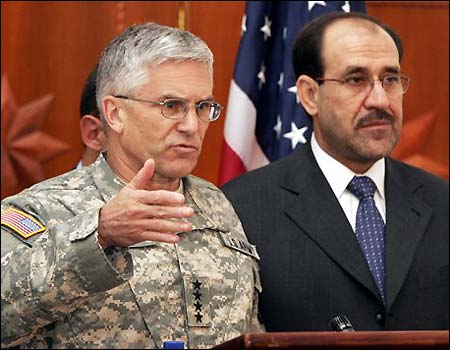
June 8: Gen. Casey, left, speaks after
Iraqi PM Nouri al-Maliki
announced that Abu Musab al-Zarqawi was killed.
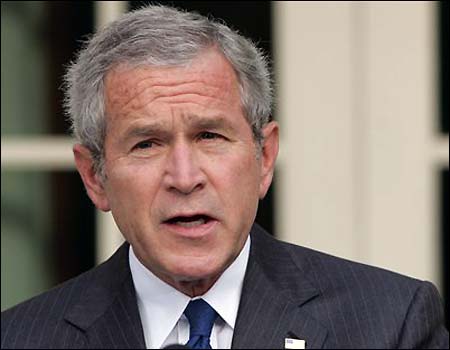
June 8: President Bush speaks in the Rose Garden about the death of Al Qaeda
in
Iraq's leader, Abu Musab al-Zarqawi.
MORE GOOD NEWS ANNOUNCED !!!
Also Thursday, Iraq's parliament approved
new ministers of Defense, Interior and National Security, ending a three-week
stalemate among Iraq's religious and ethnic groups over the crucial posts.
The new ministers are Iraqi Army Gen.
Abdul Qadir Mohammed Jassim, a Sunni Arab, for Defense and Shiites Jawad al-Bolani
for Interior and Sherwan al-Waili for National Security.
The three men were sworn in after Nouri al-Maliki announced the death of al-Zarqawi.
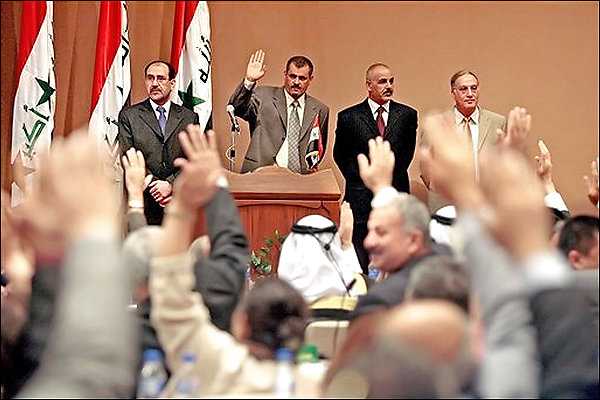
Three Final Ministers Sworn
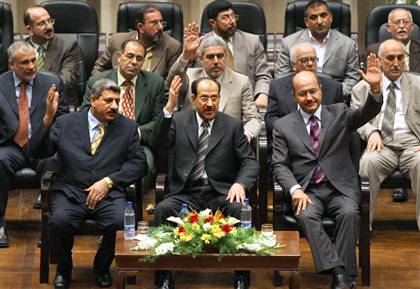
Iraqi
parliamentarians raise their hands as a sign of approval to the new security
ministers appointed Thursday, June 8, 2006
in Baghdad by Iraqi Prime Minister Nouri al-Maliki, left, who appears standing
next to National Security Minister Sherwan
al-Waili, 2nd left, Shiite interior minister Jawad al-Bolani, 2nd right, and
Sunni Defense Minister Iraqi Army Gen. Abdul Qadir
Muhammed Jassim , far right, in Baghdad, Iraq Thursday, June 8, 2006.
Iraq's parliament approved new Ministers of Defense,
Interior and National
Security on Thursday, ending a three week stalemate among Iraq's sectarian and
ethnic parties
over the crucial posts.
President Bush made a surprise visit to Baghdad Tuesday, June
13, 2006
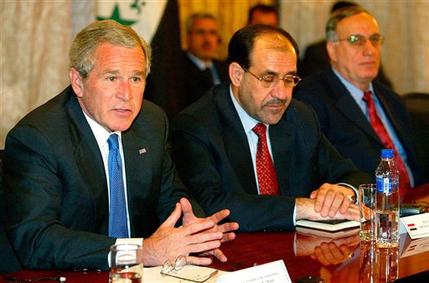
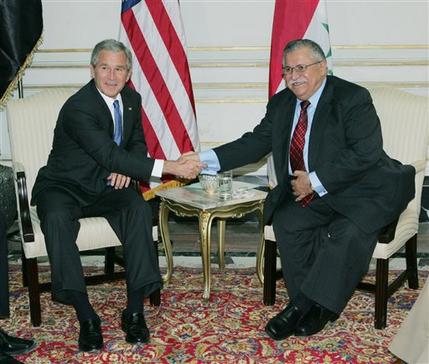
President Bush, Iraqi Prime Minister
Nouri al-Maliki and
President Bush shakes hands with Iraqi President Jalal Talabani
Minister of Defense, Abdul Qadir Mohammed Jassim
at
a surprise meeting at the US Embassy in Baghdad.
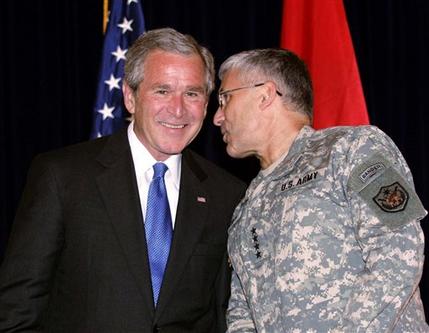
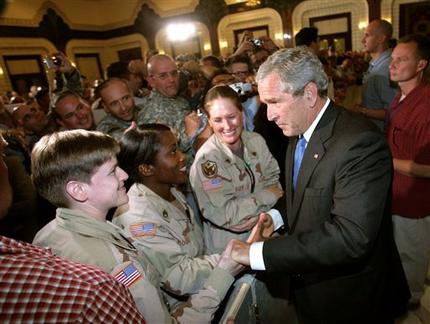
President Bush with General Casey after his meeting with al-Maliki
President Bush talks with the US troops during his visit.
THE LONG AWAITED DAY !!!
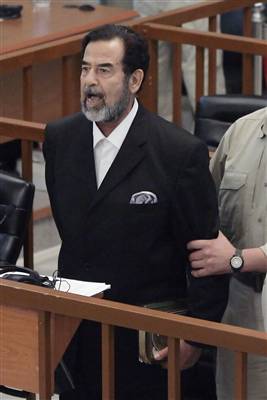
Sunday, November 5, 2006
BAGHDAD, Iraq — Saddam Hussein, the iron-fisted dictator who ruled Iraq for
nearly a quarter of a century, was found guilty of crimes against humanity
Sunday and sentenced to death by hanging.
The so-called Butcher of Baghdad, who was president of Iraq from 1979 until he
was deposed by Coalition forces in April 2003, was convicted of the 1982
killings of 148 Shiites in the city of Dujail.
The visibly shaken former leader shouted "God is great!" as Iraq's High Tribunal
announced his sentence.
Saddam's half brother and former intelligence chief Barzan Ibrahim, and Awad
Hamed al-Bandar, head of the former Revolutionary Court, were sentenced to join
Saddam on the gallows for the Dujail killings after an unsuccessful
assassination attempt during a Saddam visit to the city 35 miles north of
Baghdad.
During Sunday's hearing, Saddam initially refused the chief judge's order to
rise; two bailiffs lifted the ousted ruler to his feet and he remained standing
through the sentencing.
Saddam and seven co-defendants were on trial for killing 148 Shiites in a wave
of revenge in the city of Dujail following a 1982 assassination attempt.
Saddam's half brother Barzan Ibrahim was also sentenced to hang. Former Iraqi
Vice President Taha Yassin Ramadan got life in prison for premeditated murder.
Three others were found guilty of murder and sentenced to 15 years behind bars.
One, a Baath Party official, walked free because of insufficient evidence.
The death sentences automatically go to a nine-judge appeals panel which has
unlimited time to review the case. If the verdicts and sentences are upheld, the
executions must be carried out within 30 days.
Mohammed and Omar Fadel, of Iraq The Model, write their first impressions after
Saddam Hussein’s death sentence was delivered.
I was overwhelmed with joy and relief as I watched the criminals being read
their verdicts. For the first time in our region tyrants are being punished for
their crimes through a court of law.
Until this moment and while I’m typing these words I’m still receiving words of
congratulations in emails, phone calls and text messages from friends inside and
outside the country. These were our only means to share our happiness because of
the curfew that limits our movement.
This is the day for Saddam’s lovers to weep and I expect their shock and grieve
to be huge. They had always thought their master was immortal so let them live
in their disappointment while we live for our future.
This is a day not only for Iraqis but a historic day for the whole region; today
new basis for dealing between rulers and peoples are found.
No one is above the law anymore.
I was particularly pleased by the way Judge Raouf Rasheed handled the session;
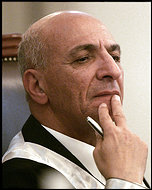 he
was reading the court’s decision and at the same time chastising members of the
current government for their misbehavior and threatened to throw them in custody
regardless of their ranks! he
was reading the court’s decision and at the same time chastising members of the
current government for their misbehavior and threatened to throw them in custody
regardless of their ranks!
We are living a new era where there’s much hope despite the difficulties…our
sacrifices have a noble cause, that is to build a new model that obviously
terrifies other tyrants.
I believe it wasn’t Saddam alone who was shaking and shouting in hysteria when
the verdict was read; I can see hysteria takes over all of Saddam’s followers
and apologists.
Today we had turned a page that was full of pain and ugly crimes that were
committed by the same criminals who were shaking in the hands of Iraq’s new
justice.
We were among the first to bring Saddam’s crimes in Dujail to the surface in
this blog almost three years ago even before cases were chosen or a tribunal was
formed.
I did that because one of my friends was a direct victim of that crime when he
was thrown in prison in the middle of the desert when he was only 7 years old
along with his mother and a younger sister and lost 30 members of his extended
family over the years of that tragedy.
Some people back then questioned the credibility of my friend’s story and
couldn’t believe the crimes of Saddam were that cruel and inhuman. But today
that the truth is out there for the whole world to see, the criminals stand
small and shaking while the families of the victims stand proud seeing justice
served.
Right now volleys of bullets ring not far from where I sit, some are fired to
express joy while others are fired in a desperate expression of denial but I
have no doubt who is going to prevail. Although the road is long but we are
walking forward and will not look back.
I salute the honorable special tribunal that challenged threats and risks and
insisted on keeping up the work until the end, and today it brought back the
pride of the land that wrote the world’s first laws.
I salute the witnesses who risked their lives to reveal the truth and expose the
crimes of the dictator.
I salute the brave men and women of the coalition who came to this land and made
this day possible.
Congratulations to all my Iraqi brothers and sisters on this glorious day.
FINAL APPEAL
BAGHDAD, Iraq Dec 26, 2006
Iraq's highest appeals court on Tuesday upheld Saddam Hussein's death
sentence and said he must be hanged within 30 days for the killing of 148
Shiites in the central city of Dujail.
The sentence "must be implemented within 30 days," chief judge Aref Shahin
said. "From tomorrow, any day could be the day of implementation."
On Nov. 5, an Iraqi court sentenced Saddam to the gallows for ordering the
1982 killings following an attempt on his life.
Under Iraqi law, the appeals court decision must be ratified by President
Jalal Talabani and Iraq's two vice presidents. Talabani opposes the death
penalty but has in the past deputized a vice president to sign an execution
order on his behalf a substitute that was legally accepted.
Raed Juhi, a spokesman for the High Tribunal court that convicted Saddam,
said the judicial system would ensure that Saddam is executed even if Talabani
and the two vice presidents do not ratify the decision.
"We'll implement the verdict by the power of the law," Juhi said. He did not
elaborate.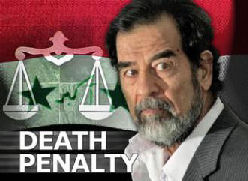
The appeals court also upheld death sentences for Barzan Ibrahim, Saddam's
half brother and intelligence chief during the Dujail killings, and Awad Hamed
al-Bandar, head of Iraq's Revolutionary Court, which issued the death sentences
against the Dujail residents.
The appeals court concluded the sentence of life imprisonment given to
former vice president Taha Yassin Ramadan was too lenient and returned his file
to the High Tribunal. Ramadan was convicted of premeditated murder in the Dujail
case.
"We demand that he be sentenced to death," said Shahin, the appeals judge.
Saddam Hussein is Executed
BAGHDAD, Iraq, December
30, 2006 -- Iraqis awoke Saturday to television images of a noose being slipped
over Saddam Hussein's neck and his white-shrouded body, the pre-dawn work of
black-hooded hangmen.
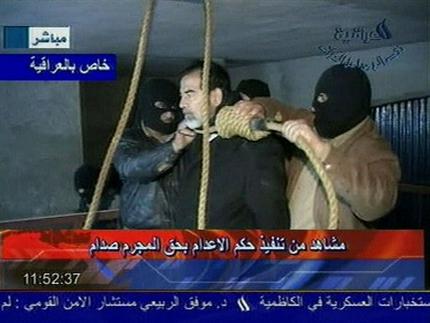
This video image released by Iraqi state
television shows Saddam Hussein's guards wearing ski masks and placing a noose
around the deposed leader's neck moments before his execution Saturday Dec. 30.
2006. Clutching a Quran and refusing a hood, Saddam Hussein went to the gallows
before sunrise Saturday.
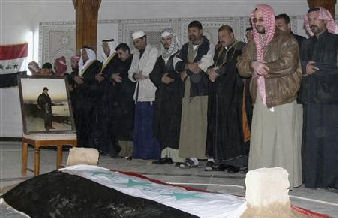
Saddam has been buried in
his hometown of Al-Ouja, south of Tikrit, before dawn Sunday, members of his
Al-Bu Nasir tribe told the Aswat Al-Iraq News Agency.
 A
tribal delegation from Tikrit had retrieved Saddam's body from the Iraqi
government earlier yesterday, after Sheikh Ali Al-Nida refused to allow Saddam's
body to be buried in Baghdad or elsewhere, Al-Arabiya TV reported. Saddam's body
was returned with the delegation on an American helicopter to Tikrit where it
was buried in the yard of the Al-Ouja Hall for Religious Ceremonies, which was
built by Saddam in the early nineties. The burial was attended by American and
Iraqi troops, in addition to members of Al-Bu Nasir, Saddam's tribe, and the
governor of Salah Al-Din at 4 a.m. Sunday. A
tribal delegation from Tikrit had retrieved Saddam's body from the Iraqi
government earlier yesterday, after Sheikh Ali Al-Nida refused to allow Saddam's
body to be buried in Baghdad or elsewhere, Al-Arabiya TV reported. Saddam's body
was returned with the delegation on an American helicopter to Tikrit where it
was buried in the yard of the Al-Ouja Hall for Religious Ceremonies, which was
built by Saddam in the early nineties. The burial was attended by American and
Iraqi troops, in addition to members of Al-Bu Nasir, Saddam's tribe, and the
governor of Salah Al-Din at 4 a.m. Sunday.
Mourners gathered at the flag-draped grave of former Iraqi leader
Saddam Hussein who was buried Sunday in Awja, near Tikrit. About 100
people, including the governor of Salaheddin, clerics, tribal leaders and
relatives attended the event, which took place at 4 a.m. (0100 GMT).
Saddam Hussein's relatives, including sons Uday and Qusay, are buried in the
same cemetery.
Saddam's Grave
Here I am. It's three a.m.
Of course I lay awake.
Sitting up to watch a tyrant hear his fate.
I do not favor death for the average man.
Caught up in lunacy he neither remembers nor understands....
But in this case I would laugh, to slice with a knife my own,
And take it up with God when at last I rest my bones.
For those days in 88, when the poison did not abate
but killed the innocent children, the mothers and the weak,
For the oldest civilization's sake, the marshes drained, so many maimed,
The Devil calls, he will take his own, back to hell, no romantic fall...
Maybe he will tremble, maybe he will fear...he has a date with the noose,
and no one will shed a tear.
I am glad that I am alive, to see him brought to so low,
May his last days be dark, let him reap what he did sew
Let him stand before God and hear his list of sins
Answer for inhumanity, crimes of kith and kin
May God be more fogiving then my own heart can abide,
May this bring small comfort to the victims of his crimes.
Guilty, Guilty, Guilty is the cry!
the flowers and faces rise up as the ghostly brave,
To make one final curse, at the foot of Saddam's grave!
Poem from:
peshmergawomen.blogspot.com
BAGHDAD, Iraq January 14, 2007
Saddam Hussein's half brother and the former head of Iraq's Revolutionary
Court were hanged before dawn Monday, Prosecutor Munqith al-Faroon said, two
weeks and two days after the former Iraqi dictator was executed in a chaotic
scene that has drawn worldwide criticism.
Barzan Ibrahim, Saddam's half brother and former intelligence chief, and
Awad Hamed al-Bandar, head of Iraq's Revolutionary Court, had been found guilty
along with Saddam of in the killing of 148 Shiite Muslims after a 1982
assassination attempt on the former leader in the town of Dujail north of
Baghdad.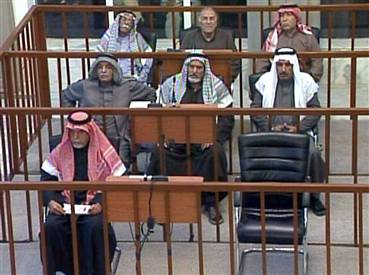
"They (government) called us before dawn and told us to send someone. I sent
a judge to witness the execution and it happened," al-Faroon said.
Two officials in Prime Minister Nouri al-Maliki's office, speaking on
condition of anonymity because they were not authorized to release the
information, confirmed that the hangings took place around 6 a.m. local time.
The executions reportedly occurred in the same Saddam-era military
intelligence headquarters building in north Baghdad where the former leader was
hanged two days before the end of 2006, according to an Iraqi general, who would
not allow use of his name because he was not authorized to release the
information. The building is located in the Shiite neighborhood of Kazimiyah.
(1st row) Awad Hamed al-Bandar, Saddam's vacate
chair,
(3rd row) last person on right, Barzan Ibrahim
Washington, January 24, 2007
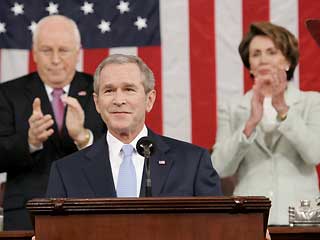
Delivering a State of the Union address to a Democratic-led Congress for the
first time, President Bush pleaded Tuesday night for members of both parties to
follow his lead and give his latest plan to end the sectarian violence in Iraq
"a chance to work."
“Our country is pursuing a new strategy in Iraq — and I ask you to give it a
chance to work,” he said. “And I ask you to support our troops in the field —
and those on their way.”
With opinion polls showing his approval ratings at an all-time low and with some
members of his own party expressing opposition to his plan, Bush acknowledged
that the war in Iraq is not the same one the U.S. entered into nearly four years
ago.
But the president said that abandoning that country to insurgents would be a
nightmare for the United States.
If the decision of the US President, George Bush, to send an extra 21,500 US
forces to Iraq to pacify Baghdad has even a remote chance of succeeding, many
observers believe it will be because David Petraeus is in charge of the
operation.
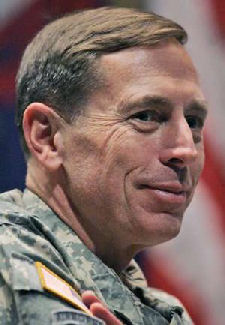
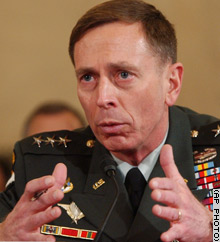
General David Petraeus
Senate confirms new top general for Iraq
January 26, 2007
WASHINGTON - The Senate on Friday voted unanimously to confirm the nomination of
Army Lt. Gen. David Petraeus, 54, to command U.S. troops in Iraq at a time
when President Bush is building up American forces there.
Petraeus' 81-0 approval was in contrast to the widespread public and
congressional opposition to Bush's plan to send 21,500 more troops to Iraq.
Congress is moving toward votes in coming weeks on nonbinding resolutions
opposing the troop build up.
Despite the majority of Senate Democrats - and an increasing number of
Republicans - being opposed to the Bush surge they voted as one to confirm
General Petraeus. Some observers felt that this left the general in a strange
position: with the Democrats voting to send him to Iraq after telling him they
had no faith in what he planned to do there.
The Battle to secure Baghdad
The following from:
The Fourth Rail
http://billroggio.com/
February 7, 2007
The Surge and the Baghdad Security Operation. A process,
not an event.
News that an Iraqi Army brigade and 2,000 American troops have begun an
operation in the Sunni dominated neighborhood of Azamiyah has kicked off
speculation the Baghdad Security Operation is now underway in full force. Expect
the forces to establish one or more Combat Outposts (or COPs) in Azamiyah. But
the fact is the operation to stabilize the capital and the surrounding provinces
is only in its infancy. Today's positioning of forces Azamiyah is but one more
opening move on the chessboard.
February 10, 2007
General David Petraeus takes command of US troops in Iraq today
US and Iraqi forces launch awaited large scale security operation in Baghdad.
A crucial component of the new Iraq security plan is securing the capital city
of Baghdad. The plan is to split Baghdad into two subcommands (Divisions) east
and west of the Tigris River.
An Iraqi Army general has assumed command of the overall
operation, with U.S. units in support.
The U.S. has devoted 9 combat Battalions plus Training Teams and Quick Reaction
Forces, about 17,500 troops, to augment the 10 Iraqi Army combat Brigades, 8
Iraqi National Police Brigades and local police forces.
The U.S. battalions will pair up with the Iraqi Army Brigades and police units,
and establish approximately 30 Joint Security Stations (JSS) within the
neighborhoods. From the JSS, US, Iraqi Army and police forces will maintain a
permanent presence in the neighborhoods, conduct patrols and direct
reconstruction projects.
News that an Iraqi Army brigade and 2,000 American troops have
begun an operation in the Sunni dominated neighborhood of Azamiyah has kicked
off speculation the Baghdad Security Operation is now underway in full force.
Expect the forces to establish one or more Combat Outposts (or COPs) in Azamiyah.
But the fact is the operation to stabilize the capital and the surrounding
provinces is only in its infancy. Today's positioning of forces Azamiyah is but
one more opening move on the chessboard.
February 11, 2007
American troops locked down a large industrial area of eastern Baghdad on Sunday
while Prime Minister Nuri Kamal al-Maliki, without indicating how he would do
it, vowed to speed the deployment of Iraqi forces throughout the war-ravaged
capital.
Mr. Maliki said Sunday that he had ordered an accelerated deployment of Iraqi
soldiers and policemen to areas considered sanctuaries for insurgents and
militias. “It will not start in just one area, but in all areas at the same
time.” Maliki is under immense pressure from his Shiite backers who say
their neighborhoods are becoming increasingly vulnerable to attacks by Sunni
insurgents.
Of things that go bump in the night.
Feb 11, 2007
by PJM Baghdad Editor Omar Fahdil of Iraq the Model
Portions of his post below.
Baghdad is still enjoying some days of
relative calm interrupted only with minor sporadic incidents. In general there’s
a feeling that these days are better than almost any other time in months. This
is more evident in the eastern side of Baghdad than the western part, because
the former part has received more US and Iraqi military reinforcements than the
latter.
Checkpoints in Baghdad are becoming more abundant, with more attention paid to
the exits and entrances of the city. I’m also hearing that those checkpoints
have been reinforced with more soldiers and equipment.
Politically, today president Talbani
visited Maliki in his office “to express support for Maliki’s security plan”.
Maliki said after the meeting that operations would quickly gain momentum in the
coming days, and that the troops will make efforts help displaced citizens
return to their homes.
Al Sadr flees Iraq
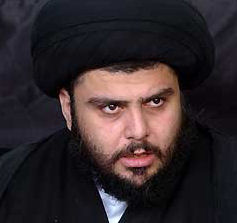
According to senior military officials, Moqtada al Sadr and some of the top
leadership left Baghdad two to three weeks ago and fled to Tehran, Iran.
Al Sadr commands the Mahdi army, one of the most formidable insurgent militias
in Iraq, and his move coincides with the announced U.S. troop surge in Baghdad.
Sources believe al Sadr is worried about an increase of 20,000 U.S. troops in
the Iraqi capital. One official said, "He is scared he will get a JDAM [bomb]
dropped on his house."
Shiite cleric Moqtada al Sadr said he refuses to sleep in the same bed
twice, fearing he will be apprehended by joint U.S. and Iraqi forces.
February 23, 2007
Baghdad
Iraq The Model
by Mohammed
Portion of post:
Operation Baghdad: Week II
It's been less than two weeks since the Baghdad operation was officially
launched. This period, though short, has been full of events; both good and bad
ones.
Here we are not in a rush to judge the operation unlike some media or
politicians who seek anything they can use to serve their agendas. We,
Baghdadis, only want this operation to succeed and we still have some patience
to show.
2010 ELECTIONS
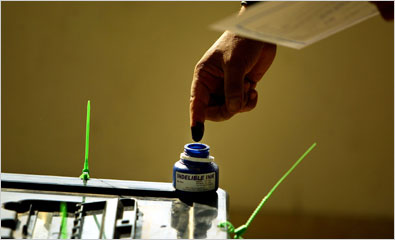
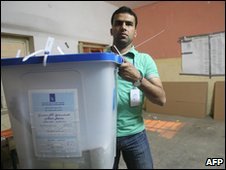
Iraq held elections on March 7, 2010, to
elect a new Parliament and possibly a new prime minister. Defying a
sustained barrage of mortars and rockets in Baghdad and other cities, Iraqis
went to the polls in large numbers. It was arguably the most open, most
competitive election in the nation's long history of colonial rule,
dictatorship and war.
The voter turnout in Iraq's general elections was 62%, officials said,
despite attacks that killed 38 people.
Preliminary results are not expected for several days but the turnout figure
is down from the 75% who voted in the 2005 general elections.
Prime Minister Nouri Maliki's State of Law Coalition is widely expected to
win the most seats.
But it is unlikely one party will form a government alone and there may be
months of negotiations on a coalition.
IRAQI GENERAL ELECTION
Voting to elect 325-member parliament.
About 19 million eligible voters out of 28 million
Around 6,200 candidates from 86 factions competing
200,000 security personnel on duty in Baghdad
Key issues: Security, services and disqualification of
alleged Baathists
Previous votes: Jan 2005 (transitional national assembly),
Oct 2005 (constitution), Dec 2005 first post-invasion parliament, Feb 2009
(local elections)
Officials from the Independent High Electoral Commission estimated the
turnout in Sunday's elections was 62% of the 19 million eligible voters.
The final official results will not be declared until the end of March,
though preliminary results are expected in two or three days.
Mr Maliki's State of Law Coalition said it had done well, especially in
Baghdad and in the Shia south of Iraq.
Unnamed Iraqi officials told the news agency AFP that he was leading in
nine of Iraq's 18 provinces.
Mr Maliki faces competition from the Shia-dominated Iraq National
Alliance and the secular coalition of former Prime Minister Iyad Allawi.
An official with Mr Allawi's Iraqiya alliance said the bloc was leading
in the northern and western provinces.
Election officials gave further breakdowns of the turnout by region.
Voter turnout was reported to be 61% in the mainly-Sunni province of
Anbar, which sprawls from west of Baghdad to the borders with Syria, Jordan
and Saudi Arabia.
In the northern Kurdish-controlled autonomous area of Dohuk the turnout
was 80%, news agency AFP reported.
There had been fears that Sunnis might stay away, amid feelings of
widespread alienation from the political process after a widespread boycott
of the 2005 elections.
Some 500 candidates, mostly Sunnis, were banned from running because of
their alleged connections to the banned Baath party of former leader Saddam
Hussein.
Despite the attacks in Baghdad and other cities including Mosul,
Fallujah, Baquba and elsewhere, the election has been hailed as a
"milestone" in Iraq's history.
Insurgents had threatened to disrupt the elections, but there were no
large-scale suicide bombings as many had feared.
The most deadly strike was on an apartment block in Baghdad which
collapsed, killing 25 people.
"Today's voting makes it clear that the future of Iraq belongs to the
people of Iraq," Mr Obama said.
FROM GLOBAL VOICES
We are just tired from living in horror, we don't want to lose more people
we love, this war was bloody and I just want it to end and be a bad memory
in my life. I wonder if my relatives abroad will come back... Iraqis want
their lives back… I can't wait till the day I'll wake up and open the
curtains in my room and see life in my neighborhood again instead of a ghost
city, I can't wait till the day that we'll remove the wood we placed over
the windows...
I want to hear good news about rebuilding my country... not how many
people who were killed. is an 18-year-old Iraqi blogger from the city of
Mosul, who voted for the first time
DUSK IN IRAQ
Dusk in Iraq
by Caroline Glick
Posted August 20, 2010
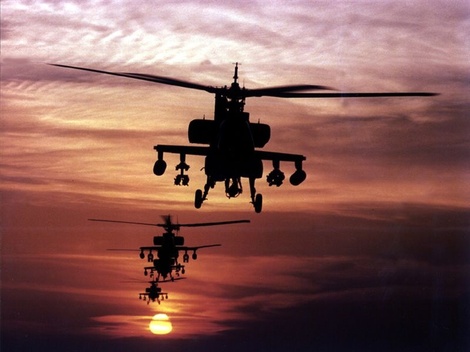
A troubling milestone arrived on Thursday,
August 19, 2010, when the US withdrew its final combat brigade from Iraq. The
remaining 50,000 US forces are charged with advising and training the Iraqi
military. President Barack Obama has pledged to withdraw them as well by the end
of next year.
When US-led allied forces invaded Iraq seven
years ago, their action raised the hopes and incited the dreams of millions
throughout the region and throughout the world.
Operation Iraqi Freedom promised to bring
the light of liberty to a corner of the world that had known none. By doing so,
it was supposed to inspire and enable men and women throughout the region to
believe that they too could be free.
But as the last US combat brigade departed
on Thursday, the Iraq they left behind was not an Arab shining city on an Iraqi
hill. The Iraq they withdrew from has no government.
The post-March 7 elections coalition talks
are hopelessly deadlocked. Prime Minister Nouri al-Maliki has agreed to serve as
the head of a caretaker government for now and take no major decisions about
Iraq's future. In a word, Iraq suffers from governmental paralysis.
Then there is the US-trained and -armed
Iraqi military. Recently, Iraq's most senior general, Lt.-Gen. Babakir Zebari,
acknowledged that Iraqi forces will be unable to defend the country from
domestic and foreign aggression until 2020. Zebari asserted that the reason the
withdrawal of US combat forces was proceeding well was "because they [the US
forces] are still here."
This week's suicide bombing at the military
recruitment office in Baghdad in which some 61 people were murdered is part of a
growing trend in Iraq. As the US withdraws, the forces the US fought throughout
the past seven years are on the rise. Al-Qaida is reportedly behind much of the
recent violence as it seeks to convince Iraq's uneasy Sunnis to rejoin its ranks
in a continuing war against the Shi'ites. And as for the Shi'ites, their leaders
remain alternatively and often simultaneously dependent on and threatened by
Iran.
As outgoing US commander in Iraq Gen. Ray
Odierno acknowledged last month, Iran remains the largest sponsor of sectarian
violence in the country.
And so, despite the US investment of more
than a trillion dollars in Iraq, and despite the more than 4,400 US servicemen
and women who lost their lives in the country, the future of Iraq remains
uncertain at best. Certainly a coherent, moderate, US-allied and democratic Iraq
remains an elusive goal.
The US blames Iran for Iraq's political
deadlock.
It is right to do so. The election results
gave a narrow two-seat lead to former prime minister Ayad Alawi's Sunni-backed
Iraqiya party over Maliki's State of Law Shi'ite coalition.
And yet, rather than accept the results,
Iranian-allied Shi'ite politicians led by Ahmed Chalabi sued to have six members
of Alawi's party denied the right to assume office due to their past ties to
Saddam's Ba'athist party.
Although the lawsuit was defeated in May,
the sides continue to be unable to come to an agreement that would enable the
Iraqi parliament to come into office or a government to be formed.
Iran's hand is everywhere in this chaos. As
George Friedman wrote in a recent Straffor Intelligence Bulletin, it is true
that today, with 50,000 US forces still deployed in Iraq, "the Iranians do not
have the ability to impose a government on Iraq. However, they do have the
ability to prevent the formation of a government or to destabilize one that is
formed. Iranian intelligence has sufficient allies and resources in Iraq to
guarantee the failure of any stabilization attempt that doesn't please Tehran."
As Friedman notes, for Iran, keeping Iraq in
an ongoing state of instability, with sporadic periods of outright chaos, is a
low-cost, high-return investment. It denies Iraq the ability to reconstitute
itself in its traditional role as a regional counterweight balancing Iranian
power in the Persian Gulf. It also denies the US victory, erodes its will to
fight and saps it of its determination to defend the Persian Gulf from Iranian
ascendance.
As Friedman sees it, "The Iranian strategy
seems to be to make the United States sufficiently uncomfortable to see
withdrawal as attractive but not to be so threatening as to deter the
withdrawal.
"As clever as that strategy is,
however, it does not hide the fact that Iran would dominate the Persian Gulf
region after the withdrawal. Thus, the United States has nothing but unpleasant
choices in Iraq. It can stay in perpetuity and remain vulnerable to violence. It
can withdraw and hand the region over to Iran. It can go to war with yet another
Islamic country. Or it can negotiate with a government that it despises - and
which despises it right back."
There are two frustrating aspects to
Friedman's analysis and what it tells us about the prospects for the region
going forward.
THE FIRST frustrating aspect of Friedman's
diagnosis of the situation in Iraq today is just how similar it is to the
situation in Lebanon.
As in Iraq, anti-Iranian political forces
won the Lebanese elections last year. And as is the case today in Iraq, Iran's
proxies in Lebanon gridlocked coalition negotiations, and so coerced the
anti-Iranian March 14 movement candidates led by Prime Minister Saad Hariri to
agree to forge a unity government with Hizbullah. Moreover, they forced Hariri
to accept effective Hizbullah - that is, Iranian - control over his government.
This they did by demanding that Hizbullah receive enough votes in the cabinet to
give it a veto over all governmental decisions.
Hizbullah's dominant position in Lebanon was
depressingly and tragically demonstrated last week, when Hariri called on the UN
to investigate Hizbullah leader Hassan Nasrallah's allegations that Israel was
behind his father's assassination in 2005. Former prime minister Rafik Hariri's
murder in February 2005 was carried out by Hizbullah and Syria, and his son
knows this.
That he would bow to his father's murderer
is a hair raising example of how the ruthless Iranian power game works.
Lebanon's hapless prime minister rightly fears Hizbullah, Syria and Iran more
than he trusts the US. And so he remains prime minister in name only and serves
at their pleasure - the effective slave of his father's killers.
On a military level, the US's inconclusive
campaign in Iraq bears striking similarities to Israel's departure from southern
Lebanon 10 years ago. In Lebanon, as in Iraq for the US, Iran and its proxies
made it impossible for Israel and its allies in the South Lebanese Army to bring
stability to the south. Hizbullah's constant but low-key assaults on Israel and
IDF forces, punctuated by sporadic escalations, eroded the Israeli ruling
class's will to fight. So, too, the elusive character of the asymmetric enemy
made it easy for the same elites to ignore the nature of the adversarial forces
arrayed against Israel and so paved the way for Israel's retreat. This in turn
fomented Hizbullah's triumphant takeover of the south, and in due course, its
takeover of the whole of Lebanon.
THE SECOND frustrating aspect of the state
of Iraq today is what it says about the US's ability to acknowledge the
realities of the region and fashion successful strategies for contending with
its challenges.
For the past seven years, advocates of the
Iraq war and opponents of the war, Republicans and Democrats alike, have
consistently refused to understand the nature of the battlefield and what that
meant about their prospects in Iraq and the region.
Both the Bush and Obama administrations
wrongly characterized Iraq as a stand-alone war. But the fact is that Iraq has
always been a battleground of a regional war. And the main enemy in Iraq, the
main obstacle to stability and victory, is Iran. Just as Israel was unable to
beat Iran in Lebanon, and so lost to its proxy Hizbullah, so the US has been and
will remain unable to defeat Iran in Iraq. And if it maintains its current
strategy, it will be defeated by Iran's proxies.
The only way to safeguard Iraq is to
overthrow the regime in Iran. The only way to get the likes of Hariri out from
under the jackboots of Hizbullah and the Iranian-proxy regime in Damascus is to
overthrow the regime in Iran.
If it were just a question of Iraq's
well-being as a country, it would arguably make sense for the US to avoid
escalation of the war and refuse to challenge the regime in Teheran.
But Iran is not only fighting for Iraq and
it is not only fighting in Iraq. Through its proxies, Iran is also fighting in
Lebanon and is using its proxies to increase its influence throughout the
Persian Gulf, the Levant and beyond.
And with the regime just a short step or two
away from nuclear capabilities it is clear that the US strategy in Iraq was
wrong all along. It was wrong and dangerous.
The US strategy was to bring democracy to
Iraq and by doing so, inspire democratic revolutions throughout the Arab world.
Although inspiring, it was wrong first and
foremost because it was predicated on ignoring one of the basic dictates of
strategy. It failed to recognize that there were other forces in the region.
It failed to anticipate that every US move
would be countered by an Iranian move. And in failing to recognize this basic
strategic truth - even though it has been staring them in the face - the
Americans aggressively pursued a strategy that became more and more irrelevant
as time went by.
As the actions of the Hariris of Lebanon and
their counterparts in Iraq show clearly, Iran's counter-moves have always been
more forthright and compelling than the US's moves have been.
In the September issue of Commentary, Arthur
Herman depressingly sets out the Obama administration's declared plans and early
moves to gut the US military. It is obvious that regardless of Obama's political
position after the mid-term elections in November, he will not revisit the US's
current Middle East strategy, which is predicated on ignoring the Iranian
nuclear elephant in the middle of the room. He will not work to overthrow the
regime or support any forces that would overthrow the regime.
It is true that in the short term, the
prospects for the region hinge on whether or not Prime Minister Binyamin
Netanyahu has the courage to order the IDF to attack Iran's nuclear
installations. And it is also true that if an Israeli strike is sufficiently
successful, it would empower many positive forces throughout the region - from
Teheran and Kurdistan to Ankara, Damascus and Beirut.
But in the medium and long term, nothing can
replace America. And as long as the US continues on its trajectory of strategic
blindness, the Iraqis will be far from alone in their suffering.
Originally published in The Jerusalem Post.
August 31, 2010
President Obama addressed the
nation tonight on the Iraq War and announced the official end of Operation Iraqi
Freedom.
"I declare the end of Iraqi
Freedom"
In his address to the nation
tonight Barack Obama mentioned that he called President Bush today but in the
speech he does not thank him or give him credit for the successful Bush Surge…
The successful surge that Obama
vehemently
opposed.
Sad.
President Barack Obama's
administration plans to rebrand its military operation in Iraq "Operation New
Dawn," beginning September 1st.
The door is now open
for al-Qa'ida and Iran. Look
for more suicide bombings, violence and bloodshed.
STORYLINE STOPS AT
SEPTEMBER, 2010 - THERE WILL BE FOUR YEARS OF DEPLETING OUR FORCES IN
IRAQ.
Liberty, when it begins to take root, is a plant of rapid growth.
- George Washington
Some interesting links:

Click on scroll bar to return to top or
use button below

Last
Update:
September 04, 2014
|